Personalized Medical Care & Dedicated International Patient Concierge

Medical Guide
Individualized Venous Diagnosis at Ium Hazi Clinic
Ium Hazi Varicose Vein Clinic's stated approach: find the underlying cause of varicose veins by ultrasound and recommend only the treatment findings support.
Schedule a ConsultationHow Does Individualized Venous Diagnosis Avoid Unnecessary Treatment?
Medically reviewed by Dr. Dong-Hyuk Kim, Board-Certified General Surgeon, Medical Director of Ium Hazi Varicose Vein Clinic
Individualized venous diagnosis means establishing what is actually causing a patient's varicose veins before any treatment is named, and then recommending only what that finding supports. Ium Hazi Varicose Vein Clinic states this as the treatment philosophy of its Medical Director, Dr. Dong-Hyuk Kim: identify the underlying cause through precise vascular ultrasound examination, and provide the treatment — or the combination of treatments — that each patient's condition requires, without unnecessary procedures. This article explains what that sequence looks like in practice and why the order of the steps is the whole point.
The Stated Philosophy, in Order
The clinic's published philosophy has three parts, and they are arranged as a sequence rather than a list.
First, accurate identification of the underlying cause, using precise vascular ultrasound examination. Second, a treatment plan built for the individual patient. Third, the provision of only what is necessary, avoiding unnecessary procedures.
The clinic's approved description of Dr. Kim's approach makes the same sequence explicit in different words: understanding each patient's condition, developing an individualized treatment plan, and recommending appropriate treatment without unnecessary procedures.
What makes this a philosophy rather than a slogan is the ordering. A recommendation that arrives before a diagnosis is not individualized, no matter how it is described. This article sets out the clinic's own approach; it makes no claims about how other practices work.
Why the Vein You Can See Is Not the Diagnosis
The visible vein is a symptom, and treating it without understanding what produced it addresses the wrong level of the problem.
The National Heart, Lung, and Blood Institute explains that varicose veins develop when the valves inside leg veins fail, so blood that should be moving back toward the heart pools in the vein instead. The failure that starts this process usually sits in a deeper or larger vein than the one visible on the surface. Pressure is transmitted downstream into smaller veins, which then stretch, twist, and become visible.
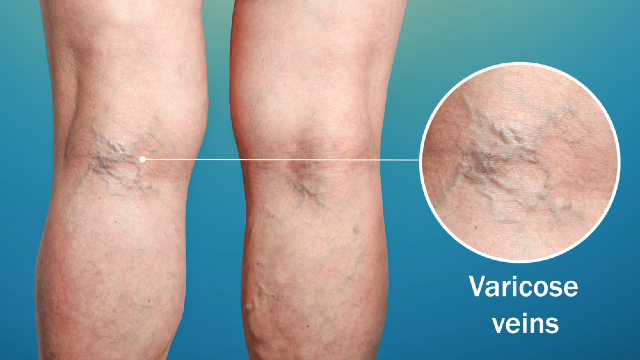
MedlinePlus, published by the US National Library of Medicine, describes varicose veins as swollen, twisted veins appearing most often in the legs, and notes that the picture ranges from visible veins with few symptoms to aching, heaviness, swelling, and skin changes. Two people with legs that look similar can have very different findings underneath.
That variability is why the surface appearance cannot be the basis of a plan. The bulge tells you where blood ended up. It does not tell you where the valve failed, how long the failing segment runs, or whether the deep veins are working normally. Only imaging answers those questions.
What the Examination Actually Covers
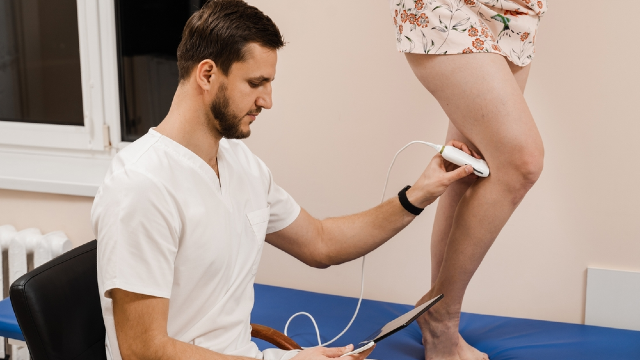
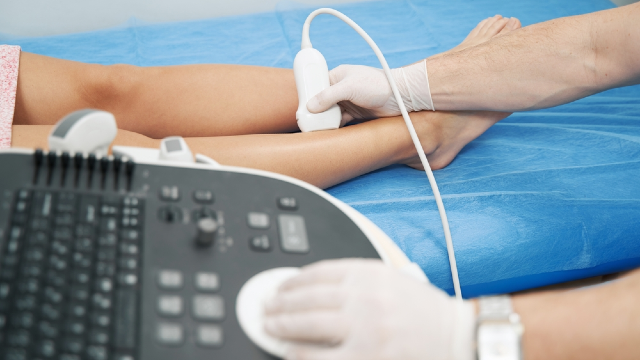
Ium Hazi Varicose Vein Clinic's stated vascular ultrasound examination is a survey of the leg's venous system rather than a look at the problem area.
The survey takes in four groups: the deep system, the saphenous trunks, the vessels sitting just beneath the skin, and the perforators that connect the superficial and deep networks. For each it records caliber, shape, and course, and it watches flow, along with reflux, which means blood running backward past a valve that has stopped sealing, at the moment it happens.
The US Food and Drug Administration explains that diagnostic ultrasound produces images of internal structures using sound waves and does not involve ionizing radiation, which is why it can be repeated as clinical circumstances require. Per the clinic, a leg vascular ultrasound generally requires no special preparation, and since nothing enters the body, there is no role for anesthesia. Most patients notice nothing beyond light pressure from the probe.
Two features of the clinic's stated process matter for what happens next. The findings are explained to the patient using both the ultrasound images and the live reflux flow, rather than a still picture alone. And on request, the examination images can be saved directly to a USB drive, so you leave with the data rather than only with a conclusion.
Under the clinic's single-director system, the physician who performs this examination is the same physician who would carry out any treatment that follows from it.
From Findings to Plan
A plan built this way is assembled from what the scan shows, which is why two patients rarely receive the same one.
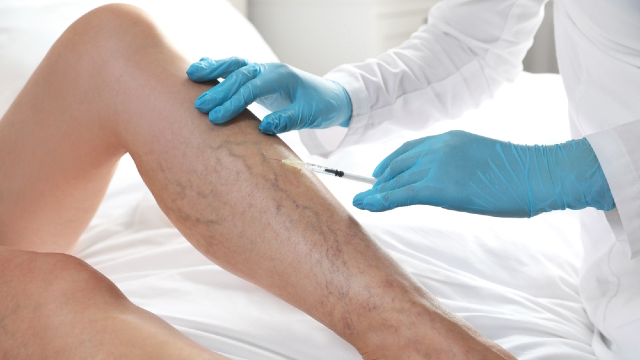
Several treatment routes are documented at Ium Hazi Varicose Vein Clinic. Heat-based closure comes as laser ablation inside the vein on a fourth-generation 1940nm system, or as radiofrequency ablation on Medtronic equipment. Closure without heat comes as VenaSeal adhesive or as mechanochemical ablation. The list continues with cryoablation, point micro-surgery through very small punctures, sclerotherapy, compression stocking therapy, and laser treatment aimed at spider veins.
The clinic states that suitability for endovenous ablation is determined after clinical examination and ultrasound evaluation, and that the affected vein, the anatomy, the symptoms, the medical history, and the patient's goals all bear on the decision. Some patients need one technique. Some need a combination — for example, closing a refluxing saphenous vein and separately removing prominent surface veins that the closure alone would not address.
Deciding among these routes is a matter of matching the technique to the finding. A vein with a particular course, size, and relationship to surrounding structures is suited to some approaches and not to others. That matching cannot happen before the map exists.
When the Answer Is Less Treatment, or None
The part of this philosophy that carries the most weight is the part that allows for a recommendation of less.
The clinic states plainly who is not a candidate for endovenous ablation. Certain vascular conditions rule it out. So can an active infection where treatment would be carried out, vein anatomy unsuited to the technique, severe peripheral arterial disease, or other medical conditions. The final judgment rests on a specialist's examination and ultrasound evaluation. Arterial disease is a particularly important example — MedlinePlus explains that peripheral arterial disease involves narrowed arteries reducing blood flow to the limbs, which is a different problem from venous reflux and has to be recognized rather than treated as if it were a vein issue.
Conservative management is also a real option rather than a consolation. Ium Hazi Varicose Vein Clinic offers compression stocking therapy as part of a patient-specific conservative plan, describing individualized assessment, appropriate compression selection, correct sizing and fitting, and follow-up. Compression is a treatment with its own role, not a waiting room for surgery.
Everyday measures belong in the same conversation. MedlinePlus's guidance on exercise and physical fitness notes that regular activity supports circulation and general cardiovascular health, and calf muscle activity is part of how leg veins return blood upward in the first place.
A finding can also point to watchful management: no procedure now, with a plan to reassess if symptoms change. That is a legitimate result of an examination, and a philosophy that makes room for it is a philosophy that can be believed when it does recommend a procedure.
What Individualized Asks of You

The approach depends on information you bring, and there are practical ways to make it work.
Bring your history, including previous vein treatments, medications, and any clotting problems in you or your family. Describe your symptoms honestly, including what your legs feel like at the end of a long day, and say clearly what you want — symptom relief, appearance, or both — because those goals can point to different plans.
MedlinePlus's guidance on talking with your doctor recommends writing your questions down in advance and repeating back what you understood, which is particularly effective when the consultation crosses a language boundary. Its material on patient rights sets out the standard for the consent conversation: you are entitled to know what is proposed, what the alternatives are, and what could go wrong before you agree.
Three questions test whether a recommendation came from your findings. What did the ultrasound show, in terms of which vein and where? Why this technique rather than the alternatives? What would happen if I did nothing for now?
The Limits of Any Diagnostic Approach
A careful diagnostic process reduces the chance of treating the wrong thing. It does not remove risk, and saying so is part of the same honesty.
Every varicose vein treatment carries risk. What Ium Hazi Varicose Vein Clinic lists as possible effects: swelling and tenderness, bruising, tightness, numbness that passes, irritated skin, and soreness following the line of the treated vein. What it lists as less common: clots, infection, skin injury, irritation of a nerve nearby, an allergic response to materials used, and a closed vein opening again. Untreated disease is not a neutral option either, with thrombosis and skin ulceration among its risks.
Diagnosis itself has limits. The clinic states that an assessment can sometimes miss or misinterpret an underlying cause, which is why thorough ultrasound evaluation matters and why findings are reviewed again over time.
Venous disease can also come back. A vein that was sound at the time of an earlier procedure may itself develop valve failure later. The clinic's stated aftercare reflects this: a follow-up examination within one week of varicose vein surgery and ultrasound monitoring within approximately one to two months, with scheduled vascular ultrasound examinations as part of postoperative care.
The appropriate starting point is therefore a diagnostic consultation in which your legs are examined and the findings are explained to you — not a procedure selected in advance from a list. You can arrange that through the clinic's contact page, and you can read the clinic's own account of how it works on its about page.
The Bottom Line
- Ium Hazi Varicose Vein Clinic states its treatment philosophy as identifying the underlying cause of varicose veins through precise vascular ultrasound and providing only the treatment or combination of treatments each patient needs.
- The visible vein is a symptom; the valve failure that produced it usually sits deeper, which is why imaging comes before any treatment recommendation.
- The clinic's stated examination covers the deep, saphenous, subcutaneous, and perforating veins, assessing size, shape, and location along with reflux observed in real time.
- A finding can support less treatment rather than more, including conservative management with compression therapy or a decision to reassess later; the clinic also states who is not a suitable candidate for endovenous ablation.
- Careful diagnosis does not eliminate risk or recurrence, which is why the clinic's aftercare includes follow-up examination and scheduled postoperative ultrasound monitoring.
Frequently Asked Questions
Why does the ultrasound come before the treatment recommendation?
Because the visible vein is a consequence rather than the cause. The National Heart, Lung, and Blood Institute explains that varicose veins arise when valves inside leg veins fail, and the failing segment is often deeper than the vein you can see. Imaging identifies which vein is refluxing and how far the problem extends, which is the information a treatment decision requires.
Does every varicose vein need to be treated?
No. Treatment depends on the findings, the symptoms, and the patient's medical circumstances, and Ium Hazi Varicose Vein Clinic states that its approach is to provide only the treatment each patient requires. MedlinePlus notes that varicose veins range from visible veins with few symptoms to aching, swelling, and skin changes. What a given leg needs is established by examination rather than assumed.
What does the clinic's ultrasound examination include?
It works through four groups of leg veins — deep, saphenous, subcutaneous, and perforating — recording caliber, shape, and course, and watching blood flow and reflux at the moment they happen. The clinic states that it goes through the findings with the patient using the pictures alongside the moving reflux display, and that the images can be copied onto a USB drive if asked for. Nothing enters the body, and no special preparation is usually needed.
What happens if I am not a candidate for a procedure?
The clinic states that suitability is determined after examination and ultrasound evaluation, and names conditions that can make endovenous ablation inappropriate, including active infection at the treatment site, unsuitable vein anatomy, and severe peripheral arterial disease. In those situations the conversation turns to alternatives, which may include conservative management. Knowing you are not a candidate is a useful result of an assessment.
Is compression therapy a real treatment or just a delay?
It is a treatment with its own role. Ium Hazi Varicose Vein Clinic describes compression stocking therapy as part of a patient-specific conservative plan involving individualized assessment, appropriate compression selection, correct sizing and fitting, and follow-up. MedlinePlus also notes that regular physical activity supports circulation, and calf muscle activity is part of how leg veins move blood upward.
How can I tell whether a recommendation is based on my findings?
Ask what the ultrasound showed in terms of which vein and where, why the proposed technique was chosen over the alternatives, and what would happen if you waited. MedlinePlus recommends preparing questions in advance and repeating back what you understood. A recommendation grounded in imaging can be explained in those terms without difficulty.
Can varicose veins come back after treatment?
Yes. A vein that was sound when an earlier procedure was carried out can develop valve failure of its own later, so closing one vein successfully does not protect the whole leg. Ium Hazi Varicose Vein Clinic's stated aftercare includes a follow-up examination within one week of surgery and ultrasound monitoring within roughly one to two months. Ongoing review is how new reflux is identified.
This article is for general informational purposes and does not constitute individualized medical advice. Candidacy, technique, and expected outcomes can only be determined through a consultation with a qualified physician, and this article is not a self-diagnosis tool.
References
- MedlinePlus: Varicose Veins
- NHLBI: Varicose Veins
- MedlinePlus: Peripheral Arterial Disease
- MedlinePlus: Exercise and Physical Fitness
- MedlinePlus: Talking With Your Doctor
- MedlinePlus: Patient Rights
- MedlinePlus: Deep Vein Thrombosis
- FDA: Ultrasound Imaging
More Articles
Continue reading our clinical guides.
Will My Varicose Veins Come Back After Treatment?
A closed vein and a new varicose vein are different events. Here is what recurrence after vein treatment in Korea means and how follow-up imaging detects it.
Learn More

What to Pack Before Flying to Korea for Vein Surgery
What to pack before flying to South Korea for vein surgery: documents, medication and supplement lists, clothing, compression, and what to arrange at home.
Learn More
What Are Varicose Veins? Causes, Symptoms, and Signs
Varicose veins are enlarged, twisted leg veins caused by valve dysfunction. Learn the causes, the symptoms they produce, and when to see a vein specialist.
Learn More