Personalized Medical Care & Dedicated International Patient Concierge

Medical Guide
Endovenous Laser Ablation vs. Radiofrequency Ablation
Laser and radiofrequency both close a refluxing vein with heat. Here is how they differ on mechanism, anesthesia, sensation, recovery, and candidacy.
Schedule a ConsultationEndovenous Laser Ablation vs. Radiofrequency Ablation: Which Is Right for Your Varicose Veins?
Medically reviewed by Dr. Dong-Hyuk Kim, Board-Certified General Surgeon, Medical Director of Ium Hazi Varicose Vein Clinic
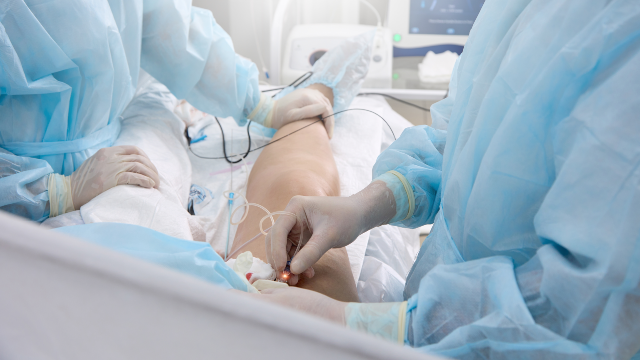
Endovenous laser ablation and radiofrequency ablation both close a refluxing leg vein using heat delivered from inside it, and both are performed at Ium Hazi Varicose Vein Clinic through a small access point with same-day discharge. The useful question is not which technique wins in general but which one fits a particular leg, a particular vein, and a particular patient. This comparison sets the two side by side on the things that actually differ.
The Common Ground First
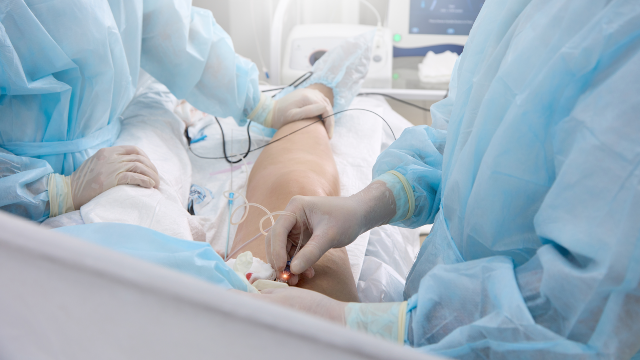
Both techniques belong to the same family: catheter-based thermal ablation performed under ultrasound guidance for confirmed venous reflux. Endovenous vein ablation, in the clinic's description, places a device inside a problematic vein — commonly the great or small saphenous — and uses energy to close it, so that blood reroutes through healthier channels.
That shared description means most of the patient experience overlaps. Both start with a vascular ultrasound that maps the deep, saphenous, subcutaneous, and perforating veins and shows reflux as it happens. Both involve a small access point rather than an incision for vein removal. Both are commonly outpatient. Both are followed by walking, structured aftercare, and follow-up imaging. The clinic states that it uses professional diagnosis to determine whether non-surgical treatment, surgery, or a combination is appropriate, and that selection reflects the patient's vascular anatomy rather than a single house method.
So the differences below are real, but they are differences within a shared approach — not a choice between two philosophies of care.
Difference One: What Actually Produces the Heat
The energy source is the first divergence. Laser ablation uses light energy delivered through a thin fiber inside the vein; the fiber is withdrawn gradually along the treated segment while energy is applied, and the vein wall reacts and closes. Radiofrequency ablation uses a catheter that heats the vein wall electrically. Ium Hazi Varicose Vein Clinic documents its radiofrequency technique as delivering constant 120°C heat in a 360-degree manner, deforming the inner lining of the vein and inducing a fibrotic reaction that closes it, using advanced radiofrequency equipment from Medtronic, USA.
The practical consequence is in how the energy is distributed. Radiofrequency, as the clinic describes it, applies a controlled temperature around the full circumference of the vein wall, segment by segment. Laser energy is delivered along the fiber's path as it is withdrawn. Dr. Dong-Hyuk Kim's listed areas of focus include 4th-generation 1940nm endovenous laser surgery as well as radiofrequency ablation, so the equipment for both is part of the practice rather than one being a substitute for the other.
The clinic itself describes radiofrequency as similar in principle to laser surgery. Both aim at the same endpoint — a closed vein — through controlled thermal injury to the vein wall. That similarity is worth holding onto when marketing language makes the two sound like different categories of medicine.
Difference Two: Anesthesia
Anesthesia is where the two look closest and where the differences are matters of plan rather than of principle. For laser ablation, the clinic lists local anesthesia, commonly local tumescent anesthesia administered around the treated vein, with additional sedation considered depending on the procedure and individual circumstances. For radiofrequency ablation, it lists local anesthesia and sedation anesthesia.
Tumescent anesthesia is a volume of dilute anesthetic placed in the tissue surrounding the vein along the treated length. For heat-based closure it does two jobs at once: it numbs the area and it puts a fluid layer between the heated vein and the tissue around it. MedlinePlus, the patient information service of the US National Library of Medicine, explains that local anesthesia numbs one part of the body while you remain awake, that sedation can be used to make you drowsy or relaxed, and that the anesthesia plan depends on the procedure and on your health.
A detail worth expecting from either technique: fluid from the anesthetic can ooze out of the puncture point for several days afterward, which the clinic describes as expected, advising a light shower rather than avoiding washing. That is a normal consequence of placing fluid around a vein, not a sign of a problem.
Both techniques at this clinic sit inside its documented "3-No" protocol for signature procedures: spinal anesthesia is not used, stitches are not removed, and no compression stocking goes on during the day of surgery itself. Ask what your own individual plan is, since aftercare is set for the patient rather than by the technique alone.
Difference Three: What Patients Report Afterward
The two have overlapping but not identical side-effect profiles, and this is where a candid comparison earns its keep.
For laser ablation, the clinic lists temporary bruising, swelling, tenderness, tightness, redness, localized numbness, or a pulling sensation along the treated vein, generally improving as healing progresses. For radiofrequency ablation, the listed side effect is temporary sensory abnormalities, and the clinic notes that a pulling sensation or lumps may occur in the treated area and gradually disappear.
Temporary sensory change appears on both lists, described as localized numbness for laser and as temporary sensory abnormalities for radiofrequency. That reflects a shared reality of heat applied near a vein that runs alongside nerves. What no honest comparison can tell you is which technique will feel better in your individual leg. Sensation after either procedure varies with the vein treated, the length treated, and the person.
Bruising is worth its own note. MedlinePlus explains that bruises form when small blood vessels under the skin break and blood leaks into surrounding tissue, and that bruises change color as they heal. Expect visible bruising after either technique and judge it by whether it is settling, not by whether it exists.
Difference Four: Recovery Timelines as the Clinic States Them
For radiofrequency ablation, Ium Hazi Varicose Vein Clinic is specific: same-day discharge is possible, most people can resume normal life the next day, and the procedure takes approximately 30 minutes to 1 hour. It advises avoiding excessive walking or overexertion if that causes discomfort.
For laser ablation, the clinic states that most patients can walk soon after treatment and gradually return to light daily activities, with bruising, tightness, or tenderness persisting for several days or weeks, and recovery varying according to the treated vein and individual healing.
Read those two statements carefully before drawing a conclusion. They are worded differently, but they are not opposites: both describe walking soon afterward, same-day or next-day return to routine activity, and temporary effects measured in days to weeks. The number of veins treated and the extent of the work influence recovery at least as much as the energy source does. Aftercare instructions are close to identical either way. Medication is taken as prescribed. Overexertion is avoided. Cigarettes and alcohol are left alone for the stated period. Driving is ruled out on the surgery day, with public transportation recommended instead, and the scheduled follow-up examinations are attended.
Difference Five: Candidacy and Technical Limits
Both techniques need a vein a device can travel along, and both have limits when the anatomy does not cooperate — but the limits are described slightly differently.
For laser ablation, the clinic names unsuitable anatomy, a vein too twisted for a fiber to be placed safely, active infection where the access point would be, and certain other vascular or medical conditions as reasons a patient may not be suitable. For radiofrequency ablation, it states that application becomes difficult where varicose disease is advanced and vessels are severely tortuous, and that cases like those demand a skilled specialist's technique.
Twisting anatomy, in other words, is a challenge for both, and it is one of the clearest reasons a clinic that offers several methods can be useful: when one device cannot follow the vein, the plan can shift rather than being forced. Alongside these two thermal options, the clinic also documents non-thermal and surgical techniques, and the choice among all of them is made after imaging.
Shared exclusions apply as well. The clinic lists certain blood-clotting conditions, active infection, severe circulation problems, and other medical concerns as reasons ablation may need to be avoided or postponed. Final suitability is determined by a vascular specialist after examination and ultrasound, which is why no comparison article can tell you which technique you qualify for.
How the Choice Is Actually Made
The decision is made from the ultrasound map, not from a preference expressed at reception. The clinician reviews symptoms and medical history, examines the legs, and uses duplex ultrasound to identify where reflux begins, which veins are affected, and which approach suits the anatomy. The US Food and Drug Administration (FDA) describes ultrasound imaging as using sound waves to picture internal structures without ionizing radiation, which is why the same mapping can be repeated afterward to assess closure.
Dr. Dong-Hyuk Kim states his philosophy as establishing the cause through precise vascular ultrasound and delivering only what a patient needs — a single technique or several — with nothing unnecessary added. Under the clinic's single-director system he performs the diagnosis, the procedure, and the follow-up personally, so the technique decision and the imaging that justifies it sit with the same physician.
A word on device claims, since both technologies are marketed heavily. The FDA publishes consumer guidance explaining that "FDA registered," "FDA cleared," and "FDA approved" carry different meanings, and that a company listing itself with the agency has not thereby obtained approval of a product. Treat any page that blurs those terms as a reason to ask more questions.
Risks That Apply to Both
Neither technique is risk-free, and the risk lists overlap heavily. For endovenous ablation generally, the clinic lists possible infection, bleeding or bruising, nerve irritation or numbness, skin changes, vein inflammation, blood clots, and, rarely, more serious complications. Laser ablation adds burns and skin injury to its specific list. Reopening of a treated vein, and recurrence in veins that were never treated, are possible after either.
Clot symptoms deserve to be recognized rather than reasoned away. MedlinePlus defines deep vein thrombosis as a clot developing inside a deep vein, typically in a leg, and warns that a dislodged piece traveling up to the lungs produces a pulmonary embolism that can kill. According to the Centers for Disease Control and Prevention (CDC), a leg clot may announce itself through swelling, aching, tenderness, warmth, or altered skin color, while one that has moved may bring breathlessness, chest pain sharpened by inhaling, or a pounding pulse. Those are emergency symptoms after either procedure.
Neither technique should be described to you as ending varicose vein disease. The clinic's own statement is that veins not treated, or newly affected ones, can develop problems later and that long-run results differ — hence follow-up ultrasound as a standard part of aftercare rather than an optional extra.
Bringing the Question to a Consultation
If you arrive with a preference, bring it as a question rather than as an instruction. Useful ones: what does my ultrasound show about the vein's course and how tortuous it is; which technique suits that anatomy and why; what anesthesia plan applies to me; what sensory changes should I expect and for how long; and how will closure be confirmed. MedlinePlus recommends writing questions down before an appointment and repeating back what you have understood, which works well for a technical decision like this one.
Ium Hazi Varicose Vein Clinic in Seocho-gu, Seoul has worked on varicose veins and nothing else since 2009. Dr. Dong-Hyuk Kim is board-certified in general surgery, studied medicine at Sungkyunkwan University School of Medicine, holds the Executive Director role at the Korean Society of Phlebology, and teaches as an adjunct professor at Samsung Medical Center. The practice cites over 15 years focused on venous work, its own published record of 7,300+ saphenous vein surgeries between 2009 and 2024, a schedule limited to one or two operations a day, sterilization by autoclave and by E-O gas, and disposable instruments that are never used twice. Registered under business number 135-91-93104, it is a Registered Medical Institution for Attracting Foreign Patients, certified under the Ministry of Health and Welfare, and it received the 2024 Medical Asia Grand Prize for varicose vein care. What the practice uses and how it works are set out on the about page; consultations are arranged through the contact page.
Traveling from the United States, budget time for the consultation, the procedure itself, recovery, and whatever follow-up your physician schedules, and get clearance to fly from the treating physician — the CDC ties long stretches of immobility on journeys to a higher risk of venous thrombosis. What a plan covers varies by insurer and by the diagnosis on record, so take that question to your own insurer.

The Bottom Line
- Both techniques close a refluxing vein with heat delivered from inside it through a small access point, and the clinic describes radiofrequency as similar in principle to laser surgery.
- The energy differs: a laser fiber delivers light energy as it is withdrawn, while the clinic's radiofrequency technique delivers constant 120°C heat in a 360-degree manner using Medtronic equipment.
- Anesthesia is local for both, with tumescent anesthesia commonly used around the vein for laser and sedation listed as an option for either.
- Temporary sensory change, bruising, tightness, and a pulling sensation appear on both side-effect lists; severely tortuous anatomy is a technical challenge for both techniques.
- The choice is made from the ultrasound map by the treating physician, and neither technique prevents new veins from developing reflux later.
Frequently Asked Questions
Is one of these techniques better than the other?
Neither is better in the abstract. Ium Hazi Varicose Vein Clinic describes radiofrequency as similar in principle to laser surgery and says that the technique is chosen to fit each patient's vein anatomy rather than one approach being applied to everyone. The meaningful comparison happens after your ultrasound, not before it.
Does the anesthesia differ between them?
Both are performed under local anesthesia, with sedation available depending on the procedure and the patient. For laser ablation the clinic commonly uses local tumescent anesthesia placed around the treated vein. MedlinePlus notes that a local anesthetic numbs only the treated area, leaving you awake, and that the anesthesia chosen reflects both the procedure and your health.
Which one has the shorter recovery?
The clinic states that radiofrequency allows same-day discharge with most people resuming normal life the next day, and that after laser ablation most patients walk soon afterward and return to light activities relatively quickly, with bruising or tightness lasting days to weeks. Extent of treatment influences recovery as much as the energy source. Your physician sets your own return-to-activity schedule.
Can either be used if my veins are very twisted?
Severely tortuous veins are a technical challenge for both. The clinic states that laser ablation may not suit a vein too twisted for a fiber to be placed safely, and reports that radiofrequency can be hard to apply in advanced disease with heavily twisted vessels, requiring skilled technique. This is decided from imaging during the consultation.
What sensory changes should I expect?
Temporary sensory change is listed for both: localized numbness after laser ablation, and temporary sensory abnormalities after radiofrequency. A pulling sensation or lumps in the treated area are also described, gradually disappearing during recovery. Report numbness that is worsening rather than settling to the clinic.
Is it normal for fluid to leak from the puncture site?
Yes. Fluid from the anesthetic can ooze out of the puncture point for several days after treatment, which the clinic describes as expected, advising a light shower meanwhile. It is a consequence of the anesthetic placed around the vein. Increasing pain, spreading redness, or fever is a different matter and should be reported.
Will the treated vein stay closed?
Successful closure is intended to be lasting, and follow-up ultrasound is used to confirm it. However, reopening of a treated vein appears on the risk list, and the clinic reports that untreated or newly affected veins may give trouble later, so results over time vary. Scheduled follow-up imaging is how this is monitored.
This article is for general informational purposes and does not constitute individualized medical advice. Candidacy, technique, and expected outcomes can only be determined through a consultation with a qualified physician, and this article is not a self-diagnosis tool.
References
- MedlinePlus: Varicose Veins
- MedlinePlus: Anesthesia
- MedlinePlus: Bruises
- MedlinePlus: Deep Vein Thrombosis
- MedlinePlus: Talking With Your Doctor
- CDC: About Venous Thromboembolism
- FDA: What Is FDA Approved?
- FDA: Ultrasound Imaging
More Articles
Continue reading our clinical guides.
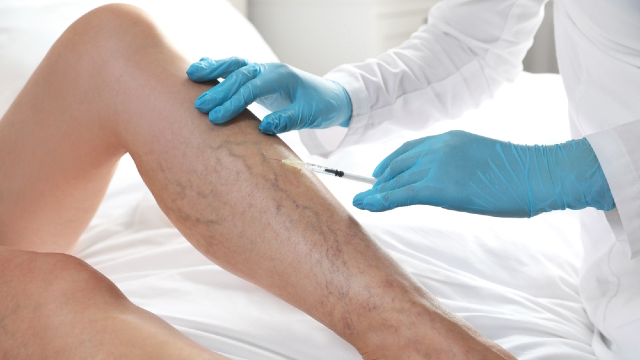
Will My Varicose Veins Come Back After Treatment?
A closed vein and a new varicose vein are different events. Here is what recurrence after vein treatment in Korea means and how follow-up imaging detects it.
Learn More
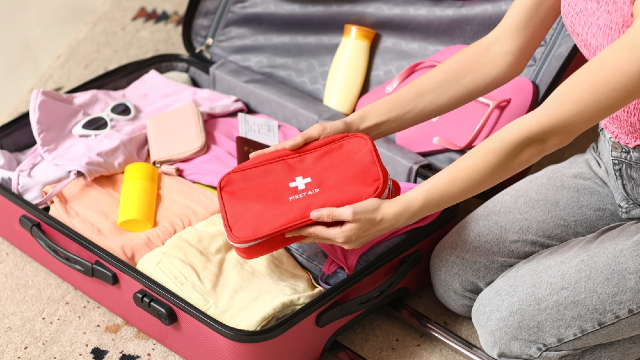
What to Pack Before Flying to Korea for Vein Surgery
What to pack before flying to South Korea for vein surgery: documents, medication and supplement lists, clothing, compression, and what to arrange at home.
Learn More
What Are Varicose Veins? Causes, Symptoms, and Signs
Varicose veins are enlarged, twisted leg veins caused by valve dysfunction. Learn the causes, the symptoms they produce, and when to see a vein specialist.
Learn More